Yuncheng, Shandong — Flatbed dump semi-trailers and hydraulic tippers are critical assets for regional bulk freight, earthworks, sand, gravel, and agricultural transport within 300-kilometer operational radii. By leveraging integrated hydraulic hoisting mechanisms, tipper semi-trailers allow automatic cargo dumping, dramatically shortening unloading times, reducing labor expenditure, and accelerating fleet turnaround cycles.
Under current national transport standards (GB1589 and mandatory GB7258 safety technical specifications), dump semi-trailers are governed by explicit legal dimension limits, load distribution rules, and hydraulic safety mandates designed to prevent highway overloading and rollover risks during unloading operations.
I. National Dimensional and Legal Standards for Flatbed Dump Semi-Trailers
National regulations enforce strict dimensional limits on commercial dump and tipper semi-trailers to ensure highway safety and structural compliance:
1. Dimensional Limits for Dump Semi-Trailers (GB1589 & GB7258)
- Maximum Overall Vehicle Length: Standard rear-dump (end-dump) semi-trailers are restricted to a maximum legal length of 13 meters (with specific short-chassis heavy mining dumpers optimized between 8.5 meters and 11.5 meters for stability).
- Maximum Overall Width: Strictly capped at 2.55 meters (or 2.6 meters for temperature-controlled units).
- Maximum Overall Height: Capped at 4.0 meters from the road surface.
- Side Box Height Restrictions: To prevent severe overloading of heavy bulk cargo like sand and ore, side-wall panel heights on dump box structures are restricted, prohibiting illegal heightened sideboards or detachable top-rail extensions.
2. Legal Load Capacities & Axle Layouts
- 3-Axle Semi-Trailer Total Combination Limit: Max legal Gross Combination Weight (GCW) is 49 tons for 6-axle tractor-trailer combinations on national highways under strict weight inspection protocols.
II. Mechanical Architecture of Hydraulic Dump Systems
A dump semi-trailer combines a structural chassis frame, a heavy-duty dump box, and a high-pressure hydraulic hoisting assembly:
1. Hydraulic Hoisting Assembly
- Power Take-Off (PTO) & Pump: The tractor engine drives the hydraulic pump through the transmission-mounted PTO, drawing oil from the reservoir and pressurizing it into the system.
- Control Valve & Distribution Unit: Regulates fluid flow and directional hydraulic pressure to raise, hold, or lower the hydraulic ram.
- Multi-Stage Telescopic Cylinder: Positioned at the front of the dump box (front-end cylinder design) or directly beneath the chassis frame (underbody linkage). Front-end multi-stage cylinders (e.g., HYVA or equivalent heavy-duty rams) offer superior lifting leverage and anti-rollover stability during unloading.
2. Rear-Dump (End-Dump) vs. Side-Dump Mechanisms
- Rear-Dump (End-Dump): The most widespread design, pivoting at the rear of the chassis frame. It features front safety cab guards, automatic tailgate release linkages, and high-strength rear pivot hinges.
- Side-Dump (Tipper): Pivots laterally to dump cargo along the side of the trailer, ideal for agricultural bulk, crushed rock, or road construction sites with overhead clearance constraints.
3. Advanced Suspension and Tire Alignment
- High-strength tandem or tri-axle mechanical suspensions feature load-equalizing torque arms and thick leaf springs to distribute axle loads evenly over rough terrain.
- Adjustable radius rods maintain precise axle tracking, reducing tire scrub and preventing premature or uneven tire wear during frequent off-road cycling.
III. Safe Operation and Hydraulic Maintenance Protocols
To preserve equipment longevity and ensure driver safety on active job sites, operators must follow structured service routines:
- Strict Weight Limit Adherence: Never exceed the certified payload or volume ratings. Overloading causes frame cracking, hydraulic cylinder seal failure, and dangerous tip-over hazards on uneven ground.
- Hydraulic System Fluid Maintenance: Inspect hydraulic fluid levels regularly, flush and replace oil according to factory service intervals, and clean internal suction filters to prevent fluid contamination.
- Controlled Hoisting Environment: Always position the tractor-trailer combination on firm, level ground before engaging the PTO to raise the dump body. Never move or drive the truck while the box is elevated.
- Regular Greasing: Lubricate rear pivot hinges, hydraulic cylinder trunnions, and tailgate locking pins at recommended intervals to prevent joint binding.
IV. Manufacturing Standards and Engineering Integrity at Yuncheng Jianxing
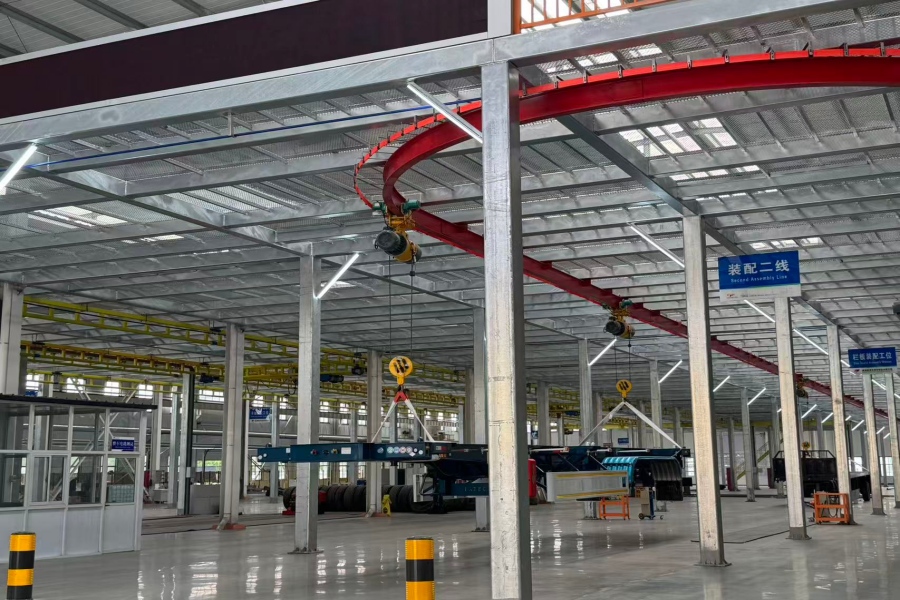
Building durable, tip-stable dump semi-trailers requires high-strength steel selection and automated welding accuracy. Operating a 140-acre smart manufacturing facility with an annual production capacity of 9,000 units, Yuncheng Jianxing Special Vehicle Manufacturing Co., Ltd. engineers heavy rear-dump and side-dump semi-trailers alongside lowbed trailers, container skeleton chassis, and drop-side fence trailers.
Serving as a designated OEM manufacturing partner for Sinotruk and Dongfeng Commercial Vehicle, Jianxing integrates 27 national utility model patents, operates under ISO9001 and CCC quality management certifications, and exports high-performance commercial vehicles to over 20 countries worldwide—including maintaining the No. 1 market share in Vietnam for 5 consecutive years.