
Yuncheng, Shandong — Improper semi-trailer alignment directly impairs vehicle tracking, accelerates irregular tire scrub, increases fuel consumption, and poses severe driving safety risks such as high-speed tail-swinging or jackknifing.
Despite the complex forces acting on multi-axle trailers, chassis alignment fundamentally relies on the geometry of an isosceles triangle—anchored by the front kingpin and balanced across each axle end. Inspecting critical suspension components and maintaining baseline alignment dimensions eliminates the root causes of uneven tire wear and vehicle drift.
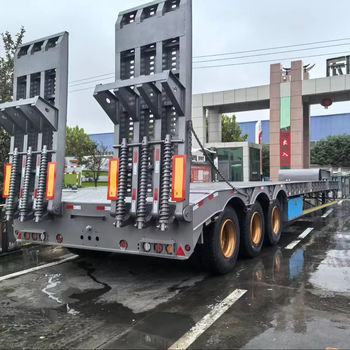
I. Key Chassis Component Inspections Prior to Alignment
Before measuring or adjusting axle turnbuckles, ensure that all load-bearing and guiding components are structurally sound and free of play:
1. Torque Arm (Radius Rod) Bushings
The torque arm transfers traction forces from the frame to the axle housing. Worn, cracked, or degraded rubber/polyurethane torque arm bushings allow the axle to shift under load, causing severe edge wear on tires. Inspect and tighten lockbolts, and replace deteriorated bushings before attempting wheel alignment.
2. Equalizer (Balance Beam) Assembly
The equalizer balances payload weight evenly across tandem or tri-axle configurations. Unequal side-to-side wear on equalizer pins or unequal leaf spring arching causes localized axle overload, leading to irregular "shell-shaped" or wavy tire tread wear.
3. Leaf Spring Bundles
As the primary vertical suspension component, leaf springs cushion road shock. Broken leaves or sagging spring packs reduce axle height on one side, forcing the axle out of perpendicular alignment and accelerating localized tire tread abrasion.
4. Kingpin Centering & Distortion
The kingpin serves as the apex towing point connecting the trailer to the tractor's fifth wheel. Thermal distortion during frame welding can cause left-to-right off-center alignment (factory tolerances should remain strictly within 5 mm). An off-center kingpin causes the trailer to dog-track or swing toward the side of the deviation while driving on highways.
II. Step-by-Step Semi-Trailer Axle Alignment Protocol
Follow these structured steps to inspect and adjust axle tracking on a multi-axle semi-trailer:
1.Prepare a Flat and Level Work Area:Prerequisite.
Park the tractor-trailer combination on a clean, level concrete floor (ensure lateral elevation variance is less than 5 mm). Keep the tractor steering wheel straight, release trailer spring brakes, and chock the wheels.
Verification: Vehicle sits level without torsional twist across the leaf springs.
2.Measure Kingpin-to-Front-Axle Geometry:10 min.
Attach a steel measuring tape or precision laser alignment tool to the center of the kingpin. Measure the diagonal distance to the center of the left front axle end ($L_1$), then measure to the right front axle end ($R_1$).
Verification: Adjust the adjustable torque arm until $L_1 = R_1$ (variance strictly within $\pm 1.5 \text{ mm}$).
3.Align Tandem and Tri-Axle Spacing:15 min.
Measure the center-to-center distance between the first axle hub and second axle hub on both left ($L_2$) and right ($R_2$) sides. Repeat for the third axle ($L_3$ and $R_3$) on tri-axle configurations.
Verification: Adjust rear torque arms until $L_2 = R_2$ and $L_3 = R_3$ (variance within $\pm 1 \text{ mm}$).
4.Torque and Lock Hardware:5 min.
Tighten all torque arm clamp bolts, equalizer pin locknuts, and U-bolts to manufacturer torque specifications.
Verification: Fasteners are fully torqued and locking tabs or jam nuts are firmly engaged.
III. Diagnostic Pre-Check and Visual Indicators
Before taking tape measurements, fleet technicians can visually estimate axle misalignment exceeding 5 mm by checking:
- Tire-to-Hanger Clearance: Compare the gap between the inner tire sidewall and spring hanger bracket on the left vs. right sides.
- Leaf Spring Centering: Check if leaf spring packs sit centered inside the equalizer and hanger guides without rubbing against the side plates.
- Tread Scrub Patterns: Diagonal feathering across the entire tread face indicates total axle misalignment, while inner/outer edge wear points to loose torque arm bushings or bent axle housings.
IV. Manufacturing Standards and Precision Engineering at Yuncheng Jianxing
Eliminating vehicle dog-tracking and premature tire wear begins with rigid frame manufacturing and laser-aligned axle mounting. Operating a 140-acre smart manufacturing facility with an annual production capacity of 9,000 units, Yuncheng Jianxing Special Vehicle Manufacturing Co., Ltd. engineers heavy-duty lowbed semi-trailers, container skeleton chassis, drop-side fence trailers, and dump trailers designed for exact tracking stability.
Serving as a designated OEM manufacturing partner for Sinotruk and Dongfeng Commercial Vehicle, Jianxing integrates 27 national utility model patents, operates under ISO9001 and CCC quality certifications, and exports high-performance commercial transport equipment to over 20 countries worldwide—including maintaining the No. 1 market share in Vietnam for 5 consecutive years.