

Yuncheng, Shandong — In modern commercial logistics, the semi-trailer serves as the backbone of overland freight transport. Unlike a full trailer or rigid truck, a semi-trailer is designed with its axle assembly positioned behind the vehicle’s center of gravity (under uniform load conditions), utilizing a kingpin and fifth-wheel coupling mechanism to transfer both vertical and horizontal forces directly to the prime mover tractor.
From standard 13-meter fence trailers to heavy-duty lowbed units and container skeletons, the semi-trailer represents a blend of structural engineering, heavy metallurgy, and transport efficiency.
I. Economic Advantages: Semi-Trailers vs. Rigid Trucks
Compared to single-unit rigid trucks, semi-trailer combinations offer significant improvements in operational efficiency and total cost of ownership (TCO) across long-haul freight operations:
1. Increased Payload and Transport Efficiency
Adopting tractor semi-trailer combinations increases overall transport efficiency by 30% to 50%, enabling higher cargo volume and tonnage per trip.
2. Lower Operating and Logistics Costs
By consolidating cargo into high-capacity trailer combinations, fleet operators lower per-ton transit costs by 30% to 40%, optimizing labor and toll expenditure.
3. Reduced Fuel Consumption and Carbon Footprint
Advanced aerodynamic styling, high-strength steel frame engineering, and balanced axle load distribution reduce fuel consumption by 20% to 30% compared to multiple smaller transport runs.
4. Transformation of Logistics Architecture
The drop-and-hook capability of semi-trailers allows prime movers to uncouple loaded trailers and pick up new ones immediately. This minimizes driver waiting time, optimizes fleet utilization, and drives the evolution of modern multimodal logistics networks.
II. Core Semi-Trailer Categories in Logistics Operations
- Fence / Stake Semi-Trailers (e.g., 11m, 13m): Highly versatile for general bulk freight, agricultural products, and bagged goods, offering easy multi-side loading.
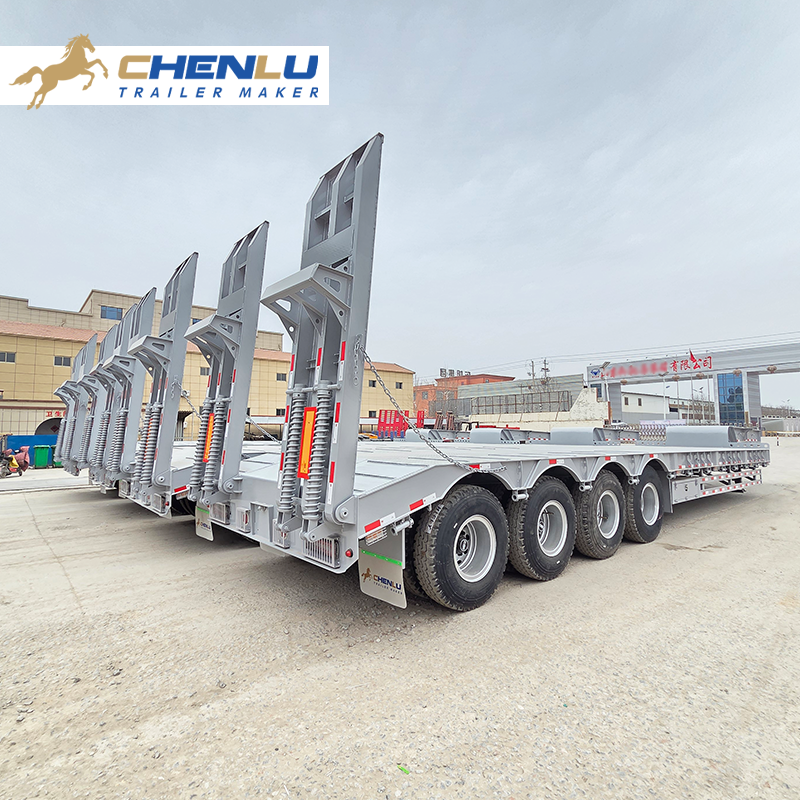
- Lowbed / Drop-Deck Semi-Trailers: Engineered with a low center of gravity and heavy-duty ramps for transporting heavy machinery, excavators, and industrial plant equipment.
- Container Skeleton (Chassis) Trailers: Equipped with ISO twist locks, designed specifically for rapid intermodal sea-to-land container logistics.
- Tipper / Dump Semi-Trailers: Built with high-strength hydraulic cylinder hoisting systems for bulk mining aggregates, sand, and ore.
III. Manufacturing Excellence and Engineering Artistry at Yuncheng Jianxing
Building high-performance semi-trailers requires precision engineering and manufacturing capability. Operating a 140-acre smart manufacturing facility with an annual production capacity of 9,000 units, Yuncheng Jianxing Special Vehicle Manufacturing Co., Ltd. specializes in precision-engineered lowbed trailers, container skeleton chassis, fence trailers, and dump trailers designed for long-distance structural reliability.
Serving as an OEM manufacturing partner for Sinotruk and Dongfeng Commercial Vehicle, Jianxing integrates 27 national utility model patents, operates under ISO9001 and CCC quality management certifications, and exports commercial transport equipment to over 20 countries worldwide—including holding the No. 1 market share in Vietnam for 5 consecutive years.